
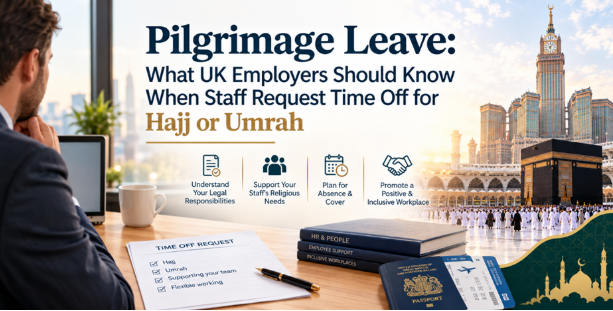
Most managers are comfortable handling a request for two weeks in Spain. A request for two weeks in Makkah can prompt more hesitation, usually not from any reluctance to grant it, but from simple unfamiliarity. How long is the trip? Can it be moved? Is there a legal obligation involved? For the many British firms with Muslim staff, pilgrimage leave is a request that comes round regularly, and handling it well is straightforward once you understand what is actually being asked.
The context is worth knowing. Umrah, the shorter pilgrimage, can be performed at almost any time of year and usually takes between one and two weeks including travel. Because employees often plan it around the best Umrah Deals from UK operators, requests can arrive with a good deal of notice, sometimes the better part of a year. Hajj is different: it falls on fixed dates in the Islamic calendar, cannot be moved, and is an obligation most Muslims hope to fulfil once in a lifetime. That distinction matters more than any other when a request lands on your desk.
The legal position, in brief
There is no standalone statutory right to religious leave in the UK. Employees take pilgrimage as part of their ordinary annual leave entitlement, or as unpaid leave if the business agrees. What does apply is the Equality Act 2010, under which religion and belief are protected characteristics. A blanket policy or an inconsistent refusal that puts staff of a particular faith at a disadvantage could amount to indirect discrimination unless the employer can objectively justify it.
In practice, that does not mean every request must be granted. Genuine operational reasons, such as a fixed seasonal peak or minimum staffing levels, can be legitimate grounds. What matters is that requests are considered properly and consistently, that the reasoning is recorded, and that the same standard is applied to everyone. Employers with any doubt about a specific case should take their own legal or HR advice rather than relying on a general article.
Why timing is not always flexible
The most common misunderstanding is assuming the dates can simply be shifted. For Hajj they cannot: the pilgrimage falls in a set window each year, and the Islamic calendar moves roughly eleven days earlier annually against the Gregorian one, so the dates change from year to year. An employee who cannot travel in that window does not get an alternative date; they wait a year.
Umrah is more flexible in principle, though less so in practice than employers sometimes assume. Many employees want to travel during Ramadan, when the pilgrimage carries the greatest reward, and school holidays limit families further. There are practical constraints too: flights, accommodation and the Umrah Visa and associated permits are usually booked together well in advance, so a request is often tied to arrangements already made. Operators such as Islamic Travel handle those bookings as a single package, which is why an employee asked to move their dates by a fortnight may be facing the loss of a deposit rather than a minor inconvenience.
Practical steps for employers
A few straightforward measures prevent most of the friction. Set out in your leave policy how requests connected to religious observance are handled, so managers are not improvising case by case. Encourage early requests, which suits both sides: the employee secures better prices, and you get far more notice for cover than a typical holiday request provides.
Train line managers to recognise the difference between Hajj and Umrah, since the two are not interchangeable in terms of flexibility. Where a request cannot be granted in full, look for alternatives before refusing outright, such as a shorter absence, a mix of paid and unpaid leave, or adjusted cover arrangements. And record your reasoning consistently, which is both good management and your best protection if a decision is ever challenged.
The business case for getting it right
Beyond compliance, there is a plain commercial argument. Recruitment and retention are expensive, and staff remember how they were treated over the things that mattered most to them. An employee granted leave for a journey they have saved years for tends to return more loyal, not less. Refuse it clumsily, or treat it as an inconvenience, and you may find yourself replacing them within the year.
There is a reputational dimension too. Firms increasingly compete on culture as much as pay, and how an organisation handles requests of this kind says a great deal about whether its stated values hold up in practice. It is also, quite simply, not a large ask: a fortnight of properly notified annual leave is well within the reach of most businesses to plan around.
A request worth planning for, not around
Pilgrimage leave is not a complicated HR problem. It is an ordinary leave request with fixed timing, deep personal significance and, for Hajj, no possibility of rescheduling. Employers who understand that, set clear expectations early and apply their policy consistently will find these requests among the easiest to accommodate, and among the most appreciated when they are.
Share your Experience With Imusafir!
