Published by iMusafir.pk | Travel Guide | Summer 2026
There is a version of Pakistan that most people who live in its cities never fully experience. It exists above 2,000 metres, where the air loses its weight and the sky becomes a different colour and the noise of ordinary life falls away so completely that you notice, for the first time in years, that you have been carrying a kind of ambient tension you did not know was there. If you are thinking to Travel Pakistan Skardu is the doorway to that version of Pakistan — and summer is when that door opens widest.
From late May through early September, Skardu transforms. The snow that locked the high passes through winter melts back to the peaks. The Deosai Plateau erupts in wildflowers. The lakes fill to their deepest blue. The roads open. The flights fill up. And the valley that sat in quiet hibernation through the cold months comes alive with the particular energy of a place that knows it has a limited season and intends to make full use of it.
If you are planning your first Skardu trip this summer — or your fourth — this guide tells you exactly what to expect: the weather, the landscape, the crowds, the highlights, the practical realities, and the things nobody mentions in the brochure.
What Summer Actually Feels Like in Skardu
The first thing to understand about Skardu in summer is that it is not the summer you know from Karachi, Lahore, or Islamabad. The valley sits at 2,228 metres above sea level, which means that while the rest of Pakistan is sweltering through a monsoon-adjacent heat that makes outdoor life genuinely difficult, Skardu is operating on an entirely different thermal register.
Daytime temperatures in June sit between 18°C and 26°C — warm enough for shirtsleeves by midday, cool enough for a light jacket in the morning. July and August follow a similar pattern, though afternoons occasionally push toward 28°C in the city itself. After sunset, the temperature drops sharply regardless of the month — evenings regularly fall to 10°C or below, and nights on Deosai Plateau can reach 0°C even in the height of July.
This thermal range is one of Skardu’s great summer gifts. You wake to cool air that feels clean in a way that city air rarely does. You spend your days in a warmth that never tips into oppressive heat. You end your evenings wrapped in a fleece, watching the last light leave the peaks, genuinely comfortable in a way that the Pakistani summer rarely permits at lower altitudes.
The sky in summer Skardu is worth its own paragraph. At this elevation, with minimal atmospheric haze and zero industrial pollution, the blue is a shade that has no accurate equivalent in most travellers’ experience — deep, transparent, physical, the kind of blue that makes you squint not from brightness but from saturation. Clouds, when they build in the afternoon, are the dramatic vertical kind — cumulus towers rising above the Karakoram ridgelines in formations that change shape by the minute. Rain in Skardu’s summer is typically brief and intense, arriving in the afternoon, departing by early evening, leaving the air scrubbed clean and the peaks newly white.
The Landscape in Full Summer Colour
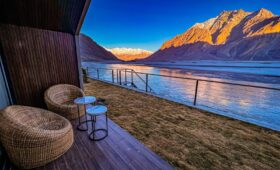
Skardu’s summer landscape is a study in extremes held in impossible proximity. The valley floor, irrigated by melt channels running from the mountains, is green and cultivated — apricot orchards, poplar avenues, terraced fields of barley and buckwheat. Minutes from this agricultural lushness, the terrain turns to bare rock and scree. Hours above the valley, the Deosai Plateau opens into 3,000 square kilometres of alpine meadow carpeted in wildflowers. And above all of it, visible from almost everywhere in the valley, the Karakoram peaks hold their permanent snow and glaciers through the hottest months without apparent effort.
This landscape diversity is what makes Skardu unlike anywhere else in Pakistan. In a single summer day, you can have breakfast beside a jade-green lake, drive through a cold desert of golden sand dunes, spend an afternoon at 4,000 metres watching brown bears in a wildflower meadow, and return to the city for dinner under a sky dense with stars. The variety is not the variety of a tourist itinerary — it is the natural variety of a geography that happens to compress an extraordinary range of terrain into a single accessible valley.
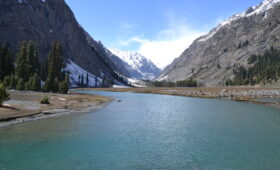
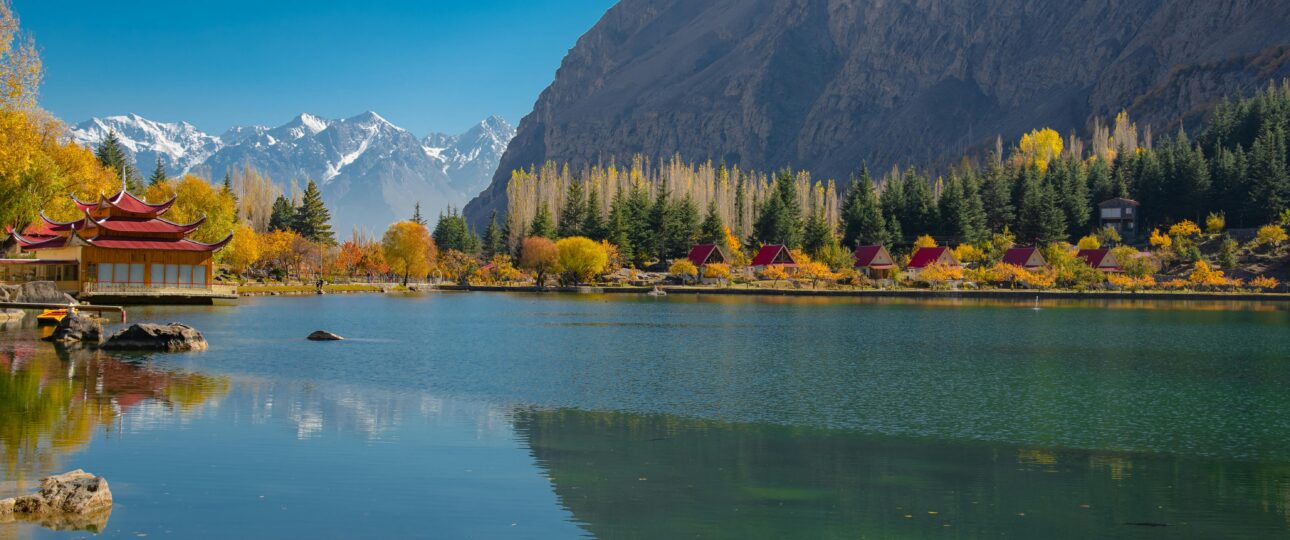
Late June through July is when the landscape peaks. The apricots ripen. The Deosai wildflowers are at maximum density. The Indus runs at its highest and most powerful, fed by accelerating snowmelt. The lakes — Satpara, Lower and Upper Kachura, Katpana — are full and at their most vivid. If you are coming for the first time and want to see Skardu at its most complete, late June to mid-July is your window. Travellers who book through iMusafir.pk’s Skardu tour packages from Karachi and Islamabad during this period consistently report it as the most visually overwhelming stretch of any northern Pakistan trip they have taken.
The Crowds — and How to Navigate Them
Summer is Skardu’s peak season, and it has become increasingly popular over the past five years as domestic tourism in Pakistan has grown significantly. The practical consequence of this is that certain places — Shangrila Resort at Lower Kachura Lake, the cold desert at Katpana, the main road through Skardu city on a weekend — can feel genuinely busy from July onward.
This is not a reason to avoid summer. It is a reason to structure your itinerary intelligently. The crowds in Skardu are almost entirely concentrated at a small number of very famous viewpoints, at predictable times of day, for predictable reasons. The solution is elementary: go earlier, go further, and occasionally go slightly differently.
The Katpana cold desert at 5 AM is empty. The same cold desert at 10 AM has vehicles parked along its edge. Upper Kachura Lake, three kilometres above the famous Shangrila Lake, is visited by a fraction of the people who stop at its twin. Satpara village, above the famous lake, sees almost no tourists at all. Shigar Valley, 45 minutes from Skardu city, is consistently quieter than the main circuit. Manthokha Waterfall in Khaplu, 90 minutes away, is practically unknown to mainstream tourism.
For travellers on a 5-day trip to Skardu, a thoughtful guide who builds your itinerary around early-morning departures and slightly off-circuit stops delivers a Skardu experience that feels private and unhurried even in peak season. The mountain does not become less beautiful because other people are also looking at it — but it does feel more personal when you are the first vehicle at the viewpoint.
What to Prioritise on a Summer Visit
Every Skardu summer itinerary should include some non-negotiables — experiences that are specific to this season and unavailable or significantly diminished at other times of year.
Deosai National Park is the most important of these. The plateau is accessible from around late June, when the road from Ali Abad clears of snow, and remains open through September. The wildflowers peak in July. The brown bears are most active through July and August. The sky above 4,000 metres in summer is a natural phenomenon with few equivalents anywhere in the world. Do not come to Skardu in summer and skip Deosai — it would be like visiting Lahore and skipping the old city.
The apricot harvest, running from mid-July through August, is a summer-specific experience that rewards travellers who seek it out actively. Shigar Valley and the villages around Khaplu are the best locations. Walking through a valley during harvest — the smell of ripe fruit, the activity of the entire community, the improbable abundance of apricots drying on every rooftop — is one of those travel experiences that has no equivalence in a list or a photograph and can only be encountered directly.
Stargazing over Katpana Desert is technically possible year-round but peaks in summer for practical reasons: the nights are cold enough to sit outside comfortably (with the right layers), the sky is reliably clear from late evening onward, and the long summer days mean you are never waiting until midnight for full dark. On a moonless night in July, the Milky Way above Skardu’s cold desert is among the most extraordinary night sky experiences available anywhere in Pakistan.
For couples planning a honeymoon or romantic trip, summer is unambiguously the right season. The combination of dramatic landscape, pleasant daytime temperatures, cool romantic evenings, and the relative accessibility of all major sites makes it ideal. iMusafir.pk’s 5-day honeymoon tour to Skardu by air is designed specifically around this season — with an itinerary that captures both the famous highlights and the quieter, more intimate corners that make a honeymoon trip feel genuinely special rather than simply scenic.
Flying vs Driving — The Summer Consideration
In summer, the question of how to get to Skardu becomes more consequential than at other times of year, for a specific reason: the Karakoram Highway through Chilas and Gilgit is subject to increased landslide activity during the summer months. Glacial lake outburst floods, rock falls, and road damage from snowmelt runoff are all more common in July and August than in other seasons, and they can add unpredictable hours — or days — to a road journey.
Flying removes this variable entirely. The 75-to-90-minute flight from Islamabad delivers you to Skardu without reference to road conditions, landslide reports, or the state of the KKH at any given point in July. For a traveller with a fixed return date and limited leave days, this reliability is as valuable as the time saving.
The single caveat about summer flights to Skardu is worth stating directly: afternoon thunderstorms occasionally cause delays or cancellations, as Skardu Airport operates under Visual Flight Rules and cannot handle low-visibility approaches. This is not common — the flight operates successfully on the vast majority of summer days — but it is worth building a buffer into your itinerary rather than booking the tightest possible connection from Skardu back to Islamabad on your final day.
Travellers flying from Karachi or Lahore connect through Islamabad. The full journey from either city to Skardu, door to hotel, typically runs between four and five hours — compared to 30-plus hours on the road from Karachi. For travelers on the 3-day Skardu tour by air from Islamabad, this is not a marginal consideration — it is the difference between a viable itinerary and an impossible one.
Packing for a Skardu Summer Trip
The single most common packing mistake Skardu summer visitors make is under-preparing for cold. The warm daytime temperatures in the valley create a false impression of what the evenings, the high-altitude sites, and the early mornings will feel like.
Bring a fleece and a windproof outer layer regardless of when in summer you travel. Pack thermal underlayers if you plan to spend time above 3,500 metres — Deosai, in particular, can turn very cold very fast when clouds move in. Bring sunscreen rated SPF 50 or higher: UV exposure at altitude is significantly more intense than at sea level, and a Skardu sunburn arrives faster than most lowland visitors expect.
Sturdy walking shoes or light hiking boots are essential for anything beyond the main roads and resort areas. Comfortable sandals have no practical role in a Skardu summer itinerary. Carry a reusable water bottle — the water at many trekking and high-altitude sites is clean enough to drink directly from streams, and staying hydrated at altitude is significantly more important than at sea level.
Final Thoughts — What Summer in Skardu Does to You
People who go to Skardu in summer return different. Not dramatically, not necessarily in ways they can articulate clearly on the drive back from the airport. But something has shifted. The mountains do something to perspective that no amount of reading about them prepares you for — they make ordinary problems smaller, ordinary beauty larger, and ordinary life both more precious and more manageable in the same moment.
Summer is when Skardu is most fully itself. The roads are open, the plateau blooms, the flights run, the days are long, and the valley is alive in every sense of the word. If you have been planning to go — next summer, someday, when the time is right — understand that the time is right now, the season is this one, and the mountains have been waiting considerably longer than you have.
Browse iMusafir.pk’s full range of Skardu tour packages by air and book before the summer season fills up. For those wanting to extend the experience into Hunza Valley, the 7-day Skardu and Hunza tour remains iMusafir.pk’s most complete northern Pakistan itinerary — and one of the finest travel experiences the country offers at any time of year.