
Published by iMusafir.pk | Travel Guide | Summer 2026
Skardu sits in the heart of Gilgit-Baltistan, cradled between some of the highest mountain ranges on earth. It is a place that has lived in the imagination of Pakistani travellers for decades — a cold desert beside glaciated peaks, jade-green lakes reflecting the Karakoram, ancient forts carved from volcanic rock, and a plateau so vast and wild it makes everything you thought you knew about scale feel entirely provisional.
Planning your first trip to Skardu can feel overwhelming. There are questions about how to get there, when to go, how many days you need, what to pack, and how to structure your time so that you actually experience the valley rather than simply driving through it. This guide answers all of those questions directly and honestly — so you arrive in Skardu prepared, confident, and ready to be completely undone by the mountains.
Step 1 — Decide When to Go
The single most important decision in planning a Skardu trip is timing. Skardu is a year-round destination in theory, but each season delivers a fundamentally different experience, and your first visit deserves the fullest version of the valley.
Summer (May to September) is the best time for a first visit. From late May onward, all major roads are open, flights operate reliably, the Deosai National Park plateau is accessible, and the landscape is at its most vivid — wildflowers on the high plateaus, apricot orchards in the valleys, and the lakes filled to their deepest blue. Daytime temperatures sit comfortably between 18°C and 26°C in the city, making outdoor exploration genuinely pleasant. Evenings are cool. The air is clean. The mountains are out in full.
June and July are the peak of the season. The Deosai Plains wildflowers are at maximum density in July. The apricot harvest runs through mid-July and August, turning the valleys of Shigar and Khaplu into fragrant, colourful, deeply human spectacles worth going out of your way to witness.
May and September offer slightly fewer crowds and excellent conditions — particularly for photography, where the softer light of shoulder season produces results that the overhead brightness of midsummer cannot match.
Winter (November to March) is beautiful in a stark, minimal way but limits access significantly. Several key sites including Deosai are closed or unreachable, flights are more frequently disrupted, and the cold demands a level of preparation that first-time visitors rarely anticipate. Save winter Skardu for your second or third visit, when you already know what you are working with.
Step 2 — Choose How to Get There
Getting to Skardu from anywhere in Pakistan essentially means choosing between two options: flying or driving. For a first-time visitor, the choice is straightforward.
Fly.
The road to Skardu from Islamabad via the Karakoram Highway covers roughly 650 kilometres and takes a minimum of 18 to 22 hours under ideal conditions — which, in summer, are not guaranteed. Landslides near Chilas, road damage from glacial melt, and the sheer physical toll of a mountain road journey that long can consume your first two days and leave you arriving at your hotel exhausted and motion-sick rather than excited and ready.
A flight from Islamabad to Skardu takes 75 to 90 minutes. The approach alone — the aircraft threading through a narrow canyon with cliff walls rising on both sides, the valley suddenly opening ahead — is one of the most dramatic experiences in domestic aviation and serves as the perfect cinematic opening to a Skardu honeymoon tour or any first visit.
PIA operates the primary route, with connections available from Karachi, Lahore, and Islamabad. Flights fill up quickly from June onward — book at least four to six weeks in advance during peak season.
The most practical approach for first-time visitors is to book a complete Pakistan tour package that includes flights, accommodation, vehicle, and guide from a single operator. This removes every logistical variable and lets you focus entirely on the experience. iMusafir.pk’s Skardu Tour Packages from Karachi and Islamabad cover all of this in a single booking — you confirm your dates, they handle everything else.
Step 3 — Decide How Many Days You Need
This is where most first-time planners underestimate. Skardu is not a place that rewards rushing, and the common mistake of booking too few days means spending your entire trip in transit between viewpoints rather than actually inhabiting any of them.
Here is a practical breakdown by trip length:
Three days is the minimum viable Skardu trip for a first-time visitor arriving by air. It covers the essential highlights — Kharpocho Fort, Shangrila Lake, the Katpana Cold Desert, and Satpara Lake — with enough breathing room to actually enjoy each place rather than photograph and flee. The iMusafir.pk 3 Days Skardu by Air Tour Package from Islamabad is designed precisely around this constraint — a tightly structured but genuinely satisfying long-weekend escape that works for professionals with limited leave.
Five days is the ideal length for a first trip. With five full days in Skardu, you cover all the main highlights plus a full-day excursion to Deosai National Park — which is, for most visitors, the defining experience of a Skardu trip and one that genuinely requires a dedicated day rather than a rushed afternoon. You also have time for Shigar Valley, a slower morning at one of the lakes, and the kind of unscheduled hour that mountain travel occasionally delivers and that no itinerary can plan for but every traveller remembers. iMusafir.pk’s 5 Days Trip to Skardu covers this complete itinerary with flights, hotel, private vehicle, and a local guide included.
For couples planning a Skardu honeymoon, five days by air with a focus on romantic pacing — sunrise excursions, private lake time, heritage fort visits — is the sweet spot. The dedicated 5 Days Honeymoon Tour to Skardu by Air from iMusafir.pk structures all of this without requiring you to manage a single logistical detail.
Seven days opens up everything. A week in the north allows you to combine Skardu with Hunza Valley in a single journey — adding Attabad Lake, Baltit Fort, and the legendary six-peak panorama from Eagle’s Nest to an already extraordinary itinerary. This is iMusafir.pk’s most comprehensive Pakistan tour package for northern travel, and the one that most seven-day visitors say they wish they had discovered before their five-day trip. The 7 Days Trip to Skardu and Hunza covers both valleys seamlessly from any Pakistani city of departure.
Step 4 — Know What to See
A first trip to Skardu should cover the sites that define the valley’s character — the ones that, in combination, give you a complete picture of what Gilgit-Baltistan actually is.
Kharpocho Fort is the starting point for most itineraries. Built by the Balti king Ali Sher Khan Anchan in the 16th century on a 400-metre volcanic rock above the Indus River, it delivers the panoramic orientation every first-time visitor needs — the entire Skardu basin spread below, the desert to the east, the green valleys to the west, the Karakoram rising in every direction.
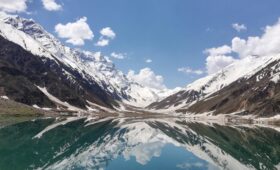
Shangrila Resort and Lower Kachura Lake is the most photographed location in Skardu and earns its reputation completely. The lake’s jade-green water, the willow-lined shores, and the mountain reflections in its surface are more beautiful in person than in any photograph you have seen. Arrive before 8 AM to have the water largely to yourself.
Katpana Cold Desert — the world’s second highest cold desert at 2,226 metres — is the site that makes first-time visitors stop mid-sentence. Sand dunes beside glaciated peaks. It makes no visual sense and is completely real. Go at dawn before any other vehicle arrives.
Deosai National Park is non-negotiable on any Skardu trip of five days or more. At 4,114 metres, the world’s second highest plateau carpets itself in wildflowers from late June onward and supports a population of wild Himalayan brown bears that represents one of the finest wildlife encounters in Pakistan. Allow a full day. Bring warm layers. Eat lunch at Bara Pani lake. Walk away from the jeep track.
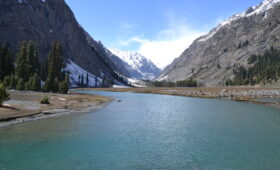
Satpara Lake is fifteen minutes from the city and a world away from anything at sea level. Shigar Fort and Shigar Valley reward half a day of slow exploration. Upper Kachura Lake, three kilometres above its famous twin, rewards the 4×4 track it takes to reach it with complete solitude and water the colour of compressed turquoise.
Step 5 — Pack for the Reality, Not the Brochure
The most common Skardu packing mistake is treating it like a summer beach trip. It is not. The valley is warm at noon and genuinely cold by 9 PM, and the high-altitude sites — Deosai, upper Kachura, the cold desert at pre-dawn — operate in a completely different temperature band from the city below.
Pack a fleece and a windproof outer layer regardless of your travel month. Skardu summer nights drop to 8–12°C in the city and below zero on Deosai. Pack thermal underlayers if high-altitude excursions are on your itinerary.
High-altitude UV exposure is significantly more intense than at sea level — SPF 50 or above is not optional. Sunglasses with UV protection are essential. A wide-brim hat adds meaningful protection on long outdoor days.
Bring sturdy walking shoes or light hiking boots. The terrain ranges from sand to rocky trails to glacial moraine, and footwear that works in a city shopping centre will limit what you can do on a Skardu itinerary.
Carry cash in small denominations — Skardu ATMs work but run dry during peak season, and sites outside the main city are cash-only. A high-capacity power bank matters more than you think in a valley where vehicle charging points are unreliable. Download offline maps before you land.
Step 6 — Book Through a Reliable Operator
Mountain travel carries real logistics that independent planning frequently underestimates — particularly on a first visit. Flight connections, vehicle routing between sites, accommodation quality in a market that varies enormously, local guides who know the difference between the jeep track and the interesting places: all of this is managed smoothly when you book through an operator who knows the region.
iMusafir.pk specialises in northern Pakistan tour packages and has designed every Skardu itinerary around the reality of mountain travel rather than the optimistic assumptions of brochure planning. Every package includes flight-inclusive options, private vehicles, accommodation, and guides — and every itinerary is built with the flexibility to accommodate the weather delays and road changes that Skardu occasionally requires.
Whether you are planning a Skardu honeymoon tour, a family holiday, a solo adventure, or a long-weekend escape, start with the full range of Skardu Tour Packages by Air on iMusafir.pk and work backward from the itinerary that fits your dates and travel style.
The mountains are not going anywhere. But the summer season fills up fast — and first trips, by definition, only happen once.
How to Get to Skardu – Recap for First-Timers
If you’re still weighing your options on how to get to Skardu, the short answer remains flying over driving — especially for a first visit. A 75 to 90 minute flight from Islamabad saves you nearly two full days compared to the road route via the Karakoram Highway, and it spares you the exhaustion of landslide-prone stretches near Chilas. Booking early during peak season (June through August) is essential, since flights fill up fast once summer travel picks up.
Skardu Beginner’s Guide 2026 – Common Questions Answered
A good Skardu beginner’s guide 2026 should leave you with fewer questions, not more — so here are quick answers to what first-time travelers ask most. How many days do you need? Five is ideal, three works for a long weekend. What should you prioritize? Deosai National Park, Shangrila Lake, and Kharpocho Fort cover the essentials. Do you need cash? Yes — carry small denominations, since ATMs outside the city are unreliable and many sites are cash-only.
Complete Skardu Planning Guide – Bringing It All Together
At its core, a complete Skardu planning guide comes down to three decisions: when to go, how to get there, and how many days to spend. Get those right, and everything else — sightseeing, packing, booking — falls into place naturally. For travelers who’d rather skip the logistics altogether, working with an operator like iMusafir.pk means flights, hotels, vehicles, and guides are all handled in a single booking, leaving you free to simply enjoy how to visit Skardu the way it deserves to be experienced.